

There is a number in the latest M+R Benchmarks report that caught my attention.
In 2025, organic search accounted for 39% of all traffic to nonprofit websites. More than half of all nonprofit website visits came from mobile devices. And across all those visitors, just 1.6% made a donation. (M+R Benchmarks 2026)
We have spent years teaching organizations that website traffic is something to grow. More people finding your organization should be a good thing. More search visibility should be a good thing. More people clicking through should be a good thing.
And generally, it is, but what happens when traffic goes up and nothing else does?

More Traffic Can Actually Lower Your Conversion Rate
NextAfter, which conducts extensive nonprofit fundraising research and experimentation, points out something that initially sounds counterintuitive: higher-traffic websites often have lower overall donation conversion rates.
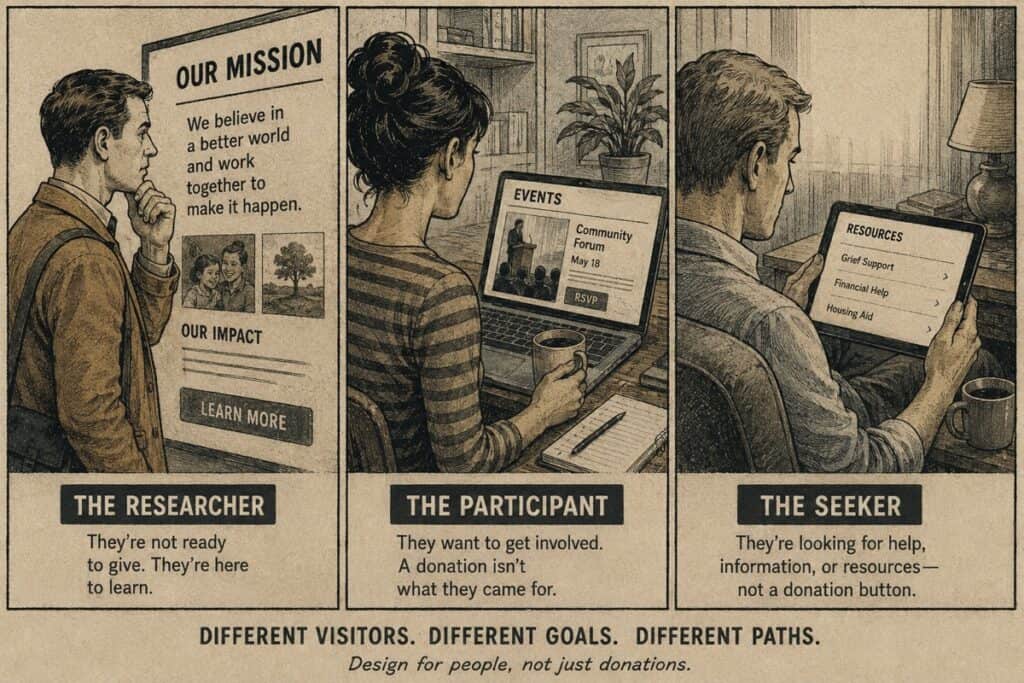
As an organization’s reach expands, its audience becomes more diverse. Some visitors are donors. Some are potential donors. Others are looking for services, reading an article, researching an issue, applying for a job, checking an event, looking for financial information, or trying to figure out what the organization actually does. (NextAfter)
Website traffic measures arrival.
It doesn’t measure success.
If your nonprofit’s website traffic increased 50% this year, I’d want to know what caused it. But I’d also want to know what happened because of it. What did those people come there to do?
We May Be Asking Too Much of One Number
Traffic is wonderfully easy to understand. Last month 8,000 people visited the website. This month 10,000 did. Up and to the right. Put it in the report.
But imagine that your organization provides educational programs.
- Your website has several possible jobs.
- A parent might need to determine whether their child qualifies for a program.
- A donor might want evidence that the program works.
- A teacher might be looking for classroom resources.
- A foundation officer might be researching your org before recommending a grant.
- A volunteer might be looking for an opportunity.
- A journalist might need a statistic.
All six visits appear in your analytics. Only one might make a donation. That doesn’t mean the other five visits failed.
We see this on our own website. Some CauseLabs resources require an email address to download. We don’t use those addresses for marketing, and we don’t really keep them because they aren’t particularly relevant to our operations. But we do see the download notifications.
Once, one came through from a NASA email address. I remember thinking how cool it was that something we created might be useful to someone at NASA. We don’t know who they were, why they needed it, or what they did with it. There was no sales conversion to measure. They didn’t become a lead. From a traditional conversion standpoint, almost nothing happened.
But I wouldn’t call that visit unsuccessful.
Seeing our work reach people inside organizations like NASA reinforces that the resources we’re creating have value beyond the audiences we already know. It encourages us to keep sharing what we’re learning.
That’s impact too. It’s just much harder to put on an analytics dashboard.
A nonprofit website strategy is more than traffic and obvious conversion rates. If success looks different for each of these visitors, then we have to ask what the website is actually supposed to accomplish, and whether we have meaningful ways to measure that impact.
What’s a Nonprofit Website Supposed to Do?
The obvious answer is usually something like: support the mission.
I think we have to go one level deeper. A nonprofit website should help specific people understand something, find something, decide something, or do something that advances the organization’s mission.
Sometimes that action is a donation. Sometimes it is registering for a program. Downloading a resource. Requesting assistance. Volunteering. Making a referral. Understanding an issue well enough to advocate for it. Trusting the organization enough to come back later.
Once we define those outcomes, we can begin asking whether the website is actually accomplishing them. That changes what and how we measure.
Instead of asking only how many people visited, we might ask how many people successfully reached important information. Whether visitors are finding the pages that matter. Where they abandon important processes. Whether people searching for services reach the right program. Whether donors understand the impact of giving before they encounter the donation form.
Analytics becomes less about reporting activity and more about understanding behavior.
Discovery Is Changing Too
This question becomes even more important as the way people discover organizations changes. For years, we could reasonably imagine a digital journey that began with a search engine:
Search → website → information → action
That path was never quite as tidy as our diagrams suggested, but it was useful.
Now someone might ask ChatGPT about organizations addressing food insecurity in Fort Worth. They might encounter a Google AI Overview explaining an issue before visiting any source. They might research an organization through social media, Charity Navigator, a news story, Reddit, or an AI assistant before ever reaching its website.
The website may no longer be the beginning of discovery. In some cases, it may not even receive the visit, but the information published there can still influence what those other systems know and communicate about the organization.
That means I don’t think the future question is simply: How do we get more people to our website?
It may increasingly become:
How do we make sure people can find, understand, trust, and act on the right information wherever discovery begins?
The website remains central to that, but its role is changing. I believe organizations that invest in their web presence, both in the technology itself and the people who manage it, should understand the impact of that investment beyond a vanity metric.
So What Should Nonprofits Measure?
There isn’t one universal metric because even within a single organization, a successful website visit can mean very different things. And there certainly isn’t one universal definition of success across all nonprofits.
M+R found that nonprofits generated an average of $1.33 in donations per website visitor in 2025. Hunger and poverty organizations generated $5.58 per visitor, with 3.3% of visitors making a donation. (M+R Benchmarks 2026)
Those benchmarks are useful precisely because they show how much context matters.
A museum website, a food bank website, a research institute, and a domestic violence organization should not define a successful visit the same way.
Start instead with three questions:
- Who needs this website?
- What do they need from it?
- What needs to happen next?
Then determine which behaviors would tell you whether that is actually happening. Traffic certainly belongs in that picture. It just shouldn’t be the picture.
The Strategy Comes Before the Scorecard
This is one of the reasons we spend so much time at CauseLabs asking questions before recommending technology.
A website redesign cannot solve a problem an organization hasn’t defined.
Neither can SEO. Neither can analytics. And AI optimization certainly can’t. Before optimizing any of them, we need to understand what we’re optimizing for.
The next time your website report shows that traffic increased, celebrate it. Then keep reading. Because 10,000 visitors who couldn’t accomplish what they came to do aren’t necessarily better than 5,000 who could. The goal isn’t simply to be found; it’s to be useful once you are.
Sources
M+R Benchmarks 2026, Website Performance:
https://mrbenchmarks.com/website-performance/
NextAfter, Digital-First Readiness:
https://www.nextafter.com/digital-first-readiness-assessment-report/
NextAfter, Online Fundraising Benchmarks:
https://benchmarks.nextafter.com/
CauseLabs helps mission-driven organizations make better decisions about their websites, technology, and digital strategy. Explore our approach to sustainable digital stewardship at causelabs.com/causelabs-partnerships.