
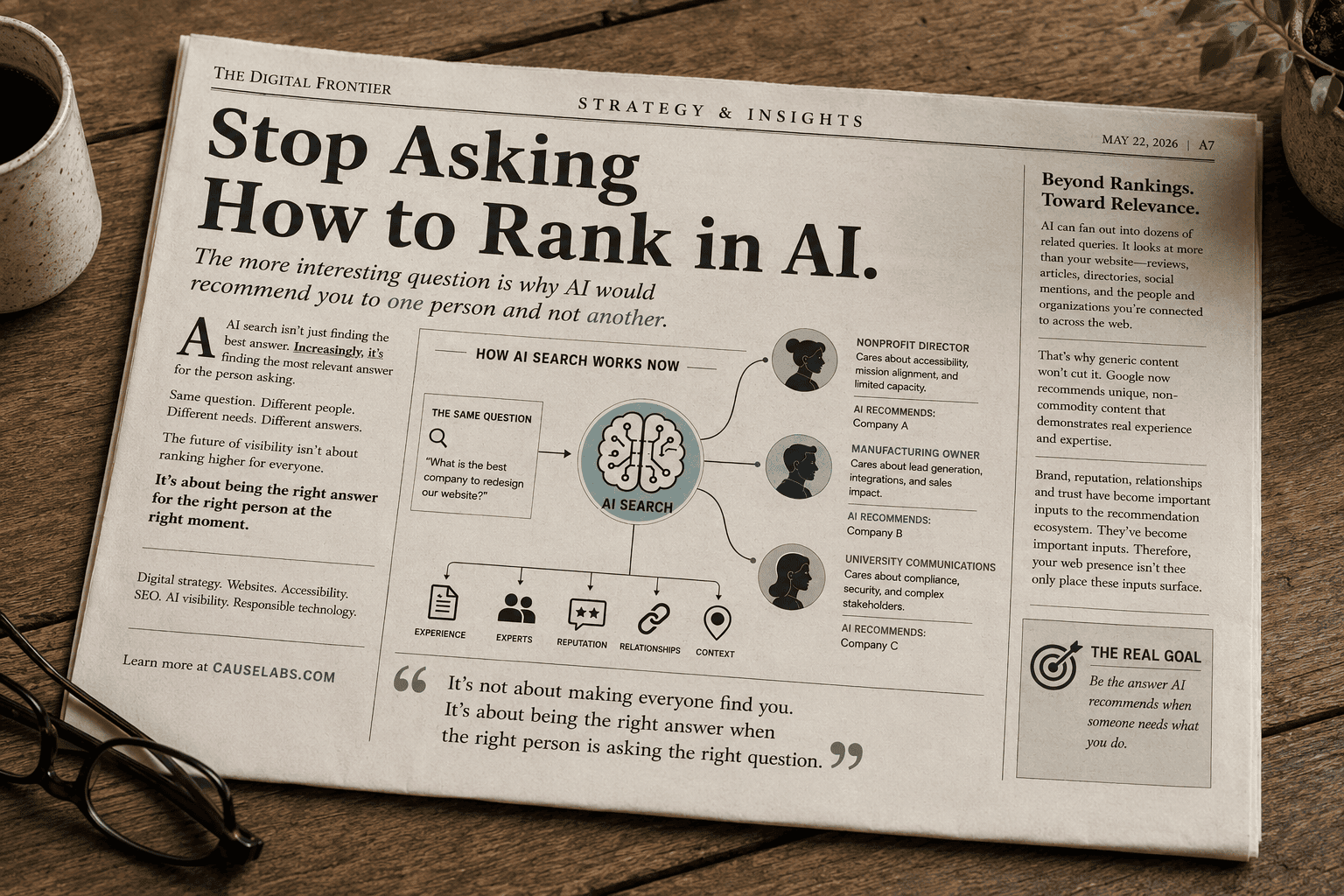
Stop Asking How to Rank in AI
For most of the internet’s history, businesses have been trying to answer some version of the same question: How do we get our website to rank higher? I think we’re reaching the point where that is no longer the most important question.
SEO still matters. Google is quite clear about that. Its current guidance says that the same foundational SEO practices we have used for years remain important for AI Overviews and AI Mode. Websites still need to be crawlable, technically sound, useful and understandable. Businesses still need authority, original content and credible information about who they are and what they do.
But AI search introduces another layer that I think is much more significant than whether we call the work SEO, AEO, GEO or whatever acronym we invent next. AI isn’t only trying to determine which website best answers a question. Increasingly, it can consider who is asking the question and what might make one answer more useful to that person than another.
The Same Question Doesn’t Necessarily Have the Same Answer
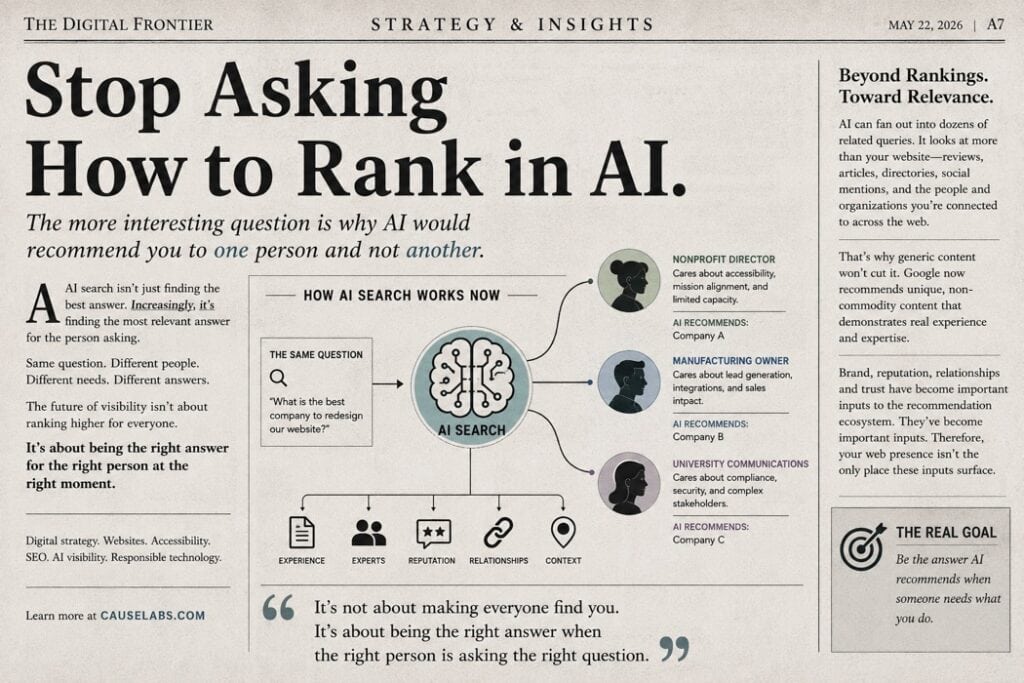
Imagine three people ask exactly the same question: “What is the best company to redesign our website?”
One is the executive director of a small nonprofit in Texas. Another runs a manufacturing company in Ohio. The third manages digital communications for a university in California.
They typed exactly the same words, but they are not making the same decision. The nonprofit leader may care about accessibility, limited internal capacity, mission alignment and whether an agency understands nonprofit boards. The manufacturer may care more about lead generation, integrations and sales. The university may need experience with procurement, security, accessibility compliance and decentralized content management.
Search has used context for years. Location, language, device and previous searches can all affect what someone sees. But generative AI is making that context considerably richer.
Google’s Personal Intelligence in AI Mode can use previous searches and activity to personalize responses when users enable those features. Users can even allow Search to connect information from Gmail, Google Calendar and Google Photos to provide additional context. Google describes the result as AI responses uniquely tailored to the individual.
ChatGPT Search is doing something related from another direction. OpenAI explains that ChatGPT may rewrite a person’s question into one or more targeted searches before deciding which sources are useful for the response.
This makes me curious about something we haven’t traditionally measured in SEO:
If two people ask AI exactly the same question, will it recommend the same businesses?
Increasingly, I don’t think we should assume that it will. And if that is true, optimizing for a universal ranking becomes a much less useful goal.
AI May Be Asking Questions You Never Typed
One of the more interesting pieces of Google’s new guidance is something called query fan-out. Instead of treating your search as one query, Google’s AI can generate multiple related queries to gather the information it needs. Google gives the example of someone asking how to fix a lawn full of weeds. Behind that one question, the system might also search for herbicides, chemical-free weed removal and ways to prevent weeds from returning.
Think about what that means for a business.
Someone might ask, “Who should build our new website?” But the information needed to make a useful recommendation could involve industry experience, location, accessibility, budget, organizational type, technical capabilities, previous work or dozens of other considerations.
We don’t know every query an AI will generate, nor should businesses try to manufacture a page for every possible variation. Google specifically warns against doing that.
The more useful exercise is to ask: What questions surround the decision to choose us? That is a very different exercise from the typical keyword research that has dominated marketing for over two decades.
What would someone need to know before hiring us? What makes us particularly good for one situation and merely average for another? What experience do we have that changes the recommendation? What evidence supports it? What would an AI need to discover elsewhere before it had enough confidence to mention us?
Those are website strategy questions, but they are also business strategy questions.
Specificity May Matter More Than Scale
Marketing has spent decades teaching businesses to describe themselves broadly. We are innovative. We are strategic. We provide customized solutions. We put customers first. We deliver results. So does everybody else. That language wasn’t particularly useful to humans, and I don’t think it gives machines much to work with either. What does give them something to work with is specificity.
Who exactly do you serve? Where? What problems have you solved repeatedly? What industries or communities do you understand unusually well? What constraints have you learned to navigate? Who on your team knows those things? What have you actually accomplished? Who else on the internet can substantiate it?
I think there is another question businesses will eventually need to get comfortable answering: When are we not the right choice?
We tend to think good marketing means making ourselves relevant to as many people as possible. But recommendation systems work better when they can distinguish between choices.
Being very clearly right for 10% of people may ultimately make a business more visible than being vaguely appropriate for everyone. That would be an interesting reversal. AI could potentially make specificity more valuable than scale.
Your Website Is Becoming Evidence
This is also why I think we need to reconsider what a website actually does. We still tend to think of the website as the destination. Someone searches. They click. They arrive at the website. We persuade them to take an action.
That behavior isn’t disappearing, but increasingly the website also exists upstream of the visit. Information from it may help an AI determine whether the organization should be mentioned in the first place. That makes the website evidence.
A case study establishes that you have solved a particular kind of problem. A team biography connects expertise to an actual person. A service page establishes a capability. A location establishes geographic relevance. An article reveals what you know and how you think. Client stories establish patterns in the kinds of organizations that trust you.
Then there is the information that doesn’t live on your website: reviews, news coverage, professional profiles, directories, associations, client websites and other credible sources that confirm or contradict what you say about yourself.
AI can connect those dots much faster than a human researching your company manually. The goal, then, isn’t simply to publish more content. It is to create enough accurate, connected evidence that a machine can understand where your organization fits in the world.
Please Don’t Respond by Publishing 100 AI Articles
There is an almost perfect irony happening right now. Businesses are using AI to produce enormous amounts of generic content at precisely the moment AI systems need generic content less than ever. We do not need another article explaining the “10 Benefits of Having a Website.” AI already knows.
What it doesn’t know is what your organization learned after redesigning 40 nonprofit websites. It doesn’t know what your customers consistently misunderstand before hiring you. It doesn’t know what failed, what surprised you, what changed your process or where your experience has caused you to disagree with conventional wisdom. That information exists because a human actually did something.
Google is now explicitly recommending what it calls unique, non-commodity content for generative AI search: expert-led information that provides value beyond what is already commonly available. It also warns that creating large quantities of content primarily to manipulate search or generative AI responses is not a sustainable strategy.
There is something wonderfully human about that outcome. We built machines capable of generating nearly unlimited content and may have inadvertently increased the value of experience.
AI Can Recommend. Humans Still Decide.
This is the piece I don’t want businesses to lose while everyone scrambles to optimize for AI.
People are still people.
We don’t make decisions based entirely on information. We choose companies because someone we trust recommended them. Because we recognize the name. Because we heard someone speak. Because we read something they wrote six months ago and remembered it. Because their work looks credible. Because they seem to understand our particular problem.
Sometimes we choose for reasons we couldn’t accurately explain if someone asked us. AI doesn’t eliminate human behavior. It becomes another influence on it.
AI may create the shortlist, but a human still looks at the choices. They visit the website. They read the About page. They look at the work. They check reviews. They ask someone they trust. They decide whether the organization feels credible and whether the people behind it understand their circumstances.
Brand, reputation, relationships and trust haven’t become obsolete because AI entered search. They’ve become important inputs. Therefore, your web presence isn’t the only place these inputs surface.
The Metric I Really Want to See
Google introduced dedicated Generative AI performance reporting in Search Console in June 2026. It gives participating website owners visibility into impressions and clicks from AI Overviews, AI Mode and generative AI features in Discover.
That is useful, but it isn’t the metric I’m most curious about. I want to know: For whom are we being recommended, and under what circumstances?
Imagine discovering that AI frequently recommends your organization to nonprofits but rarely to foundations, even though you serve both. Or that you appear when someone asks for a local provider but disappear when accessibility becomes part of the question. Perhaps you are recommended to small organizations but not larger ones, or associated strongly with one service while barely appearing for another that represents half your business.
That tells me considerably more than an impression count. It reveals how machines have interpreted the accumulated information about your organization, and that creates a fascinating new feedback loop for businesses.
For years, branding has largely been about asking, How do we want people to perceive us? AI visibility introduces another question: Based on all the available evidence, what does the internet think we are?
The gap between those two answers could become one of the most useful pieces of business intelligence we have.
Websites May Need to Explain Relationships, Not Just Organize Pages
Most websites still follow an information architecture we have used for decades: Home, About, Services, Work, Blog, Contact.
There is nothing inherently wrong with that. It makes sense for human navigation, but AI isn’t experiencing a website only as a sequence of pages. It can use the information to understand relationships.
This person has this expertise. This organization serves these communities. This service addresses these problems. This project demonstrates this capability. This client belongs to this industry. This external source corroborates this claim.
That makes me wonder whether the next meaningful evolution in websites will be less about organizing pages and more about making relationships legible. The technical layer certainly still matters. Google still recommends strong technical SEO, clear internal linking and structured data that accurately represents visible content. But technology can’t manufacture relationships that haven’t been articulated.
Who knows what? Who has done what? For whom? Where? Under what circumstances? With what result? According to whom?
Most organizations know those answers internally. Their websites often don’t communicate that content because up until now, personal relationships established that trust. As I look into the future, I want to understand if we, as a society, will double down on personal connection or if we will start to expect the machines to translate this layer of trust for us. I suspect it will be a mixture of the two and businesses who prepare for it will have a leg up.
Stop Asking How to Rank in AI
There will inevitably be an entire industry promising to help businesses “rank #1 in ChatGPT.”
Some of it will be useful. Some of it will be traditional SEO wearing a new name. Some tactics will probably work temporarily until the platforms change.
Google itself is already pushing against the idea that businesses need an entirely separate discipline for AI search. Its guidance explicitly addresses AEO and GEO and says that, from Google’s perspective, optimizing for generative AI search is still part of optimizing the search experience.
So I think we should stop asking how to rank in AI. Ask something harder: What would an intelligent system need to understand about our organization to know when recommending us would genuinely help someone? Then make those things knowable.
Publish what you actually know. Document the work you’ve actually done. Connect your people to their expertise. Be specific about who you serve and where you fit. Make your website technically understandable. Build a reputation that exists beyond your own domain. Give other credible sources reasons to reference you.
And then remember that the machine isn’t the customer. The person on the other side still is.
The future of search may not have one universal number-one result. What gets recommended may increasingly depend on who is asking, where they are, what they are trying to accomplish and what context the system has available when interpreting their question. Google is already explicitly personalizing AI responses using search history, preferences and, when users choose to connect them, information from other Google services.
That means the future of optimization may be less about making everyone find you. It may be about making it easier for the right person to find you at the moment you are the right answer. That is a much more interesting problem to solve.
What Does AI Think You Are?
At CauseLabs, this is one of the questions behind our AI Visibility work. We look beyond whether an organization appears in AI results to examine how clearly AI systems can retrieve, understand and recommend it, and where the digital evidence may be creating gaps.
Because “Does AI know we exist?” isn’t particularly useful.
I want to know what it thinks you know, who it thinks you serve, what it trusts as evidence and what changes when the person asking the question changes. That is where I think the next era of search gets interesting.
Explore more of our thinking about AI, websites and responsible technology at causelabs.com/resources.